What "digital gold" really means — the monetary case for wealth-preserving money
The dollar has lost 96%+ of its purchasing power since 1913. "Digital gold" means money that cannot be debased. Here is what the phrase actually means — and the six properties a currency must hold to protect value across a lifetime, from Menger and Hayek to Digital Gold (DGD).
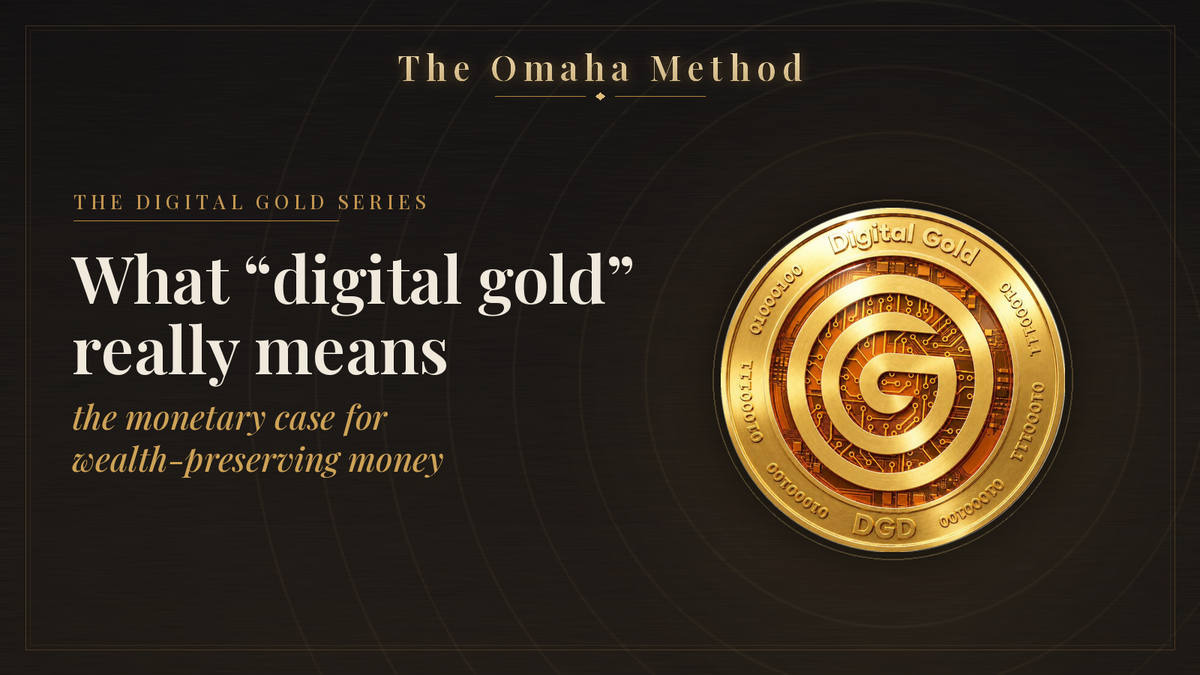
What "digital gold" really means —
the monetary case for wealth-preserving money
The dollar has lost more than ninety-six percent of its purchasing power since 1913. "Digital gold" is the idea of money that cannot be quietly debased away. Here is what the phrase actually means — and the six properties a currency must hold to protect value across a lifetime.
Start with the problem money is supposed to solve. A unit of money has one essential job: to carry purchasing power forward in time, so that the work you do today can be stored and spent tomorrow without silently shrinking. Judged against that single standard, the money most of the world uses has failed. Since the founding of the Federal Reserve in 1913, the U.S. dollar has lost more than ninety-six percent of its purchasing power. The two-percent annual inflation the central bank targets as official policy is not an accident to be corrected; it is the plan. At that rate, a worker who saves faithfully across a forty-year career will watch roughly half of a lifetime's savings consumed by deliberate monetary debasement.
This is the backdrop against which the phrase "digital gold" earns its meaning. It is not a marketing slogan and it is not a promise of riches. It is a description of a job: money engineered to hold its value rather than to leak it.
Where the phrase comes from
Gold became money long before any government decreed it. In his 1892 essay On the Origins of Money, the economist Carl Menger showed that money is not the invention of the state but something that emerges from voluntary exchange, as people gravitate toward the most saleable good — the one that is durable, divisible, portable, scarce, and widely desired. Gold won that competition for thousands of years because it held those properties better than anything else, and above all because no king could conjure more of it by decree.
Bitcoin was the first credible attempt to rebuild those properties in software. Its supply is capped at twenty-one million coins, enforced not by a promise but by code, and that ceiling has held without exception for sixteen years across a network of roughly eighty million holders. That is a genuine achievement in the history of money, and it is why Bitcoin is so often called digital gold. But the comparison also exposes a limit. Bitcoin's price swings violently, its base layer settles only a handful of transactions per second, and its fees have at times climbed past twenty dollars when the network is busy. Those traits make it an excellent store of wealth — a vault — but an awkward medium for the everyday exchange that a working economy actually runs on.
So the term "digital gold" points at two different ambitions that are easy to confuse. One is scarcity you can verify: money no authority can inflate. The other is money that actually circulates: a stable, predictable unit that people will hold and spend rather than immediately convert into dollars. A currency that preserves value has to do both.
The six pillars of perfect money
The most rigorous test of what makes money sound comes from the Austrian school of economics — Menger, Ludwig von Mises, and Friedrich Hayek. Hayek's 1976 work The Denationalisation of Money argued that governments should lose their monopoly on currency, and that private, competing currencies should be free to win or lose on the single question of whether they serve their users. Synthesized, that tradition yields six properties a currency must satisfy to qualify as what the framework calls perfect money:
Read the list closely and a pattern appears. Fiat money fails the first two pillars by design. Bitcoin passes scarcity decisively but struggles with stable pricing and, because holders tend to hoard it, with circulation. The interesting question is not whether any single asset is good or bad, but whether a currency can be engineered to satisfy all six at once.
Value protection is not speculation
This distinction is the whole point, so it is worth stating plainly. A speculative asset is one you buy hoping someone will pay more for it later; its appeal is the price chart. Wealth-preserving money is the opposite proposition: its appeal is that it does not betray you. You hold it not to win a bet but to keep what you have already earned — a safe harbour for purchasing power while the currency around it erodes.
The difference matters because it changes what "success" looks like. For a speculative token, success is a number going up fast. For wealth-preserving money, success is a unit that still buys, a decade from now, roughly what it buys today — and a price that reflects real, measurable use rather than the mood of an order book. That is a humbler claim and a far more durable one. It is also the only claim a sound currency is entitled to make.
Where Digital Gold fits
Digital Gold (DGD) is a Layer-1 cryptocurrency designed from first principles against all six pillars at once. It adopts the same twenty-one-million-coin ceiling Bitcoin proved was possible — nineteen million in maximum circulating supply, two million held permanently in treasury for staking, neither of which can ever be increased. It inherits Bitcoin's battle-tested codebase, then re-engineers the parts that keep Bitcoin from circulating: faster settlement, negligible fees, and — most distinctively — a single published price with no speculative bid/ask trading, so that a merchant who accepts DGD can hold it and pay a supplier in it without the volatility that forces everyone else to convert back to dollars at the first opportunity.
Its value is not set by an exchange order book but by a transparent formula tied to measurable network adoption and use, anchored to a fixed benchmark. The design's stated goal is not appreciation for its own sake; it is the preservation — and, if the network genuinely grows, the protection — of purchasing power against a dollar that is built to depreciate. The framework is explicit that it guarantees no such growth: the price follows the fundamentals, in whichever direction they move.
Over the coming weeks this series will take that design apart piece by piece — the benchmark and the fair-value formula, the level-by-level distribution that resists whale concentration, the single-price architecture, and the supply-chain circulation thesis that distinguishes DGD from every other coin. The aim is not to sell you a future price. It is to let you judge, on the evidence, whether a currency can be built to do the one job money was always supposed to do.
What "digital gold" actually claims
- Not a bet, a job. The phrase describes money engineered to carry purchasing power forward, not a promise of gains.
- Scarcity is necessary but not sufficient. Sound money must also circulate and hold a stable, predictable price.
- Six pillars, judged together. Scarcity, stable pricing, free adoption, decentralized governance, freedom to transact, adequate circulation.
- DGD's claim is value protection — a safe harbour for purchasing power — measured against fundamentals, never against hype.
Read the series from the first principle up
One clear idea at a time, twice a week — the case for money that protects what you earn. Join the readers following The Omaha Method.
Subscribe to the newsletter →